
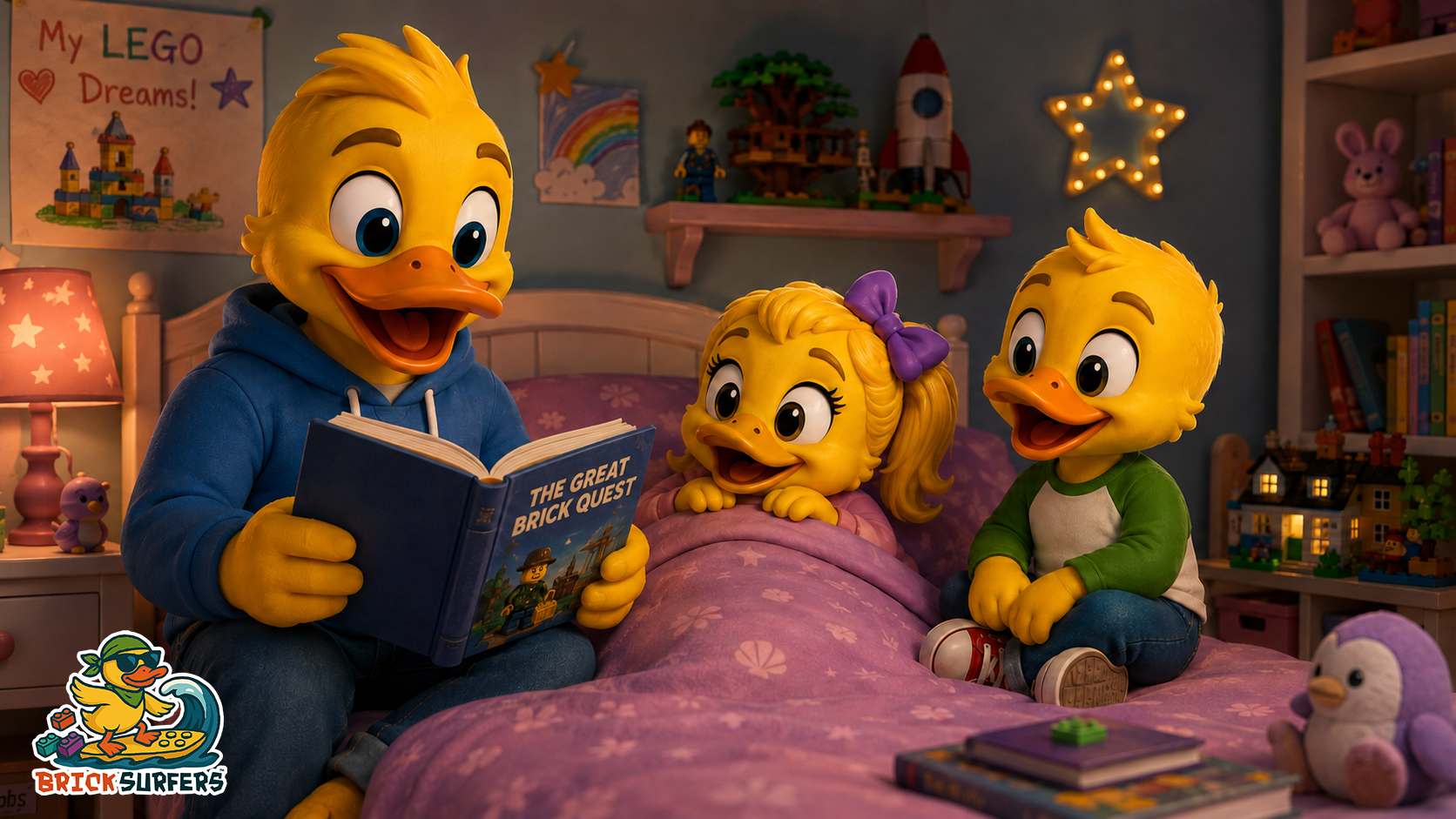
Imagine sitting down with your child each evening to read a chapter of a favorite book together.
When you finish Chapter 3, you don’t immediately close the book and say, “Well, that’s over!” You don’t throw it away because you haven’t reached the ending yet. You don’t return it to the library halfway through the story.
You put in a bookmark.
Tomorrow night, you pick up right where you left off.
I think LEGO building works much the same way.
Parents sometimes feel like every building session needs a beginning, a middle, and an end. The set gets built, the child plays with it for a while, and then everything should be taken apart before bedtime.
But that’s usually not how kids play.
One afternoon, the police officer catches the robber.
The next day, the robber escapes.
A few days later, the police officer borrows a spaceship to chase the robber across the galaxy.
Next week, everyone ends up on a pirate ship looking for buried treasure.
To a child, these aren’t separate play sessions.
They’re chapters in the same story.
That’s one of the reasons many children resist cleaning up their LEGO creations. It isn’t because they dislike helping. It’s because, in their mind, the story isn’t finished yet.
Imagine someone taking your bookmark out of your favorite novel every night and insisting you start over from Chapter 1 the next evening.
That would be frustrating.
Children often feel something similar when they’re asked to completely dismantle a creation they were planning to keep exploring tomorrow.
Of course, we can’t leave every LEGO creation sitting out forever. Most of us don’t have an entire basement to dedicate to a growing LEGO city!
But making room for the next adventure doesn’t always have to mean starting from scratch.
Sometimes it simply means finding a way to save today’s chapter until tomorrow.
Maybe that’s a small table where an important creation can stay for another day.
Maybe it’s a shallow plastic container with a lid that protects an ongoing project from curious pets or younger siblings.
Maybe it’s simply agreeing that one special build gets to stay together until the story reaches a satisfying ending.
The details will look different in every home.
The important part is remembering that LEGO building isn’t just about constructing models.
It’s about telling stories.
Sometimes those stories last twenty minutes.
Sometimes they last two weeks.
And sometimes the best thing we can do isn’t close the book.
It’s simply leave the bookmark in.