
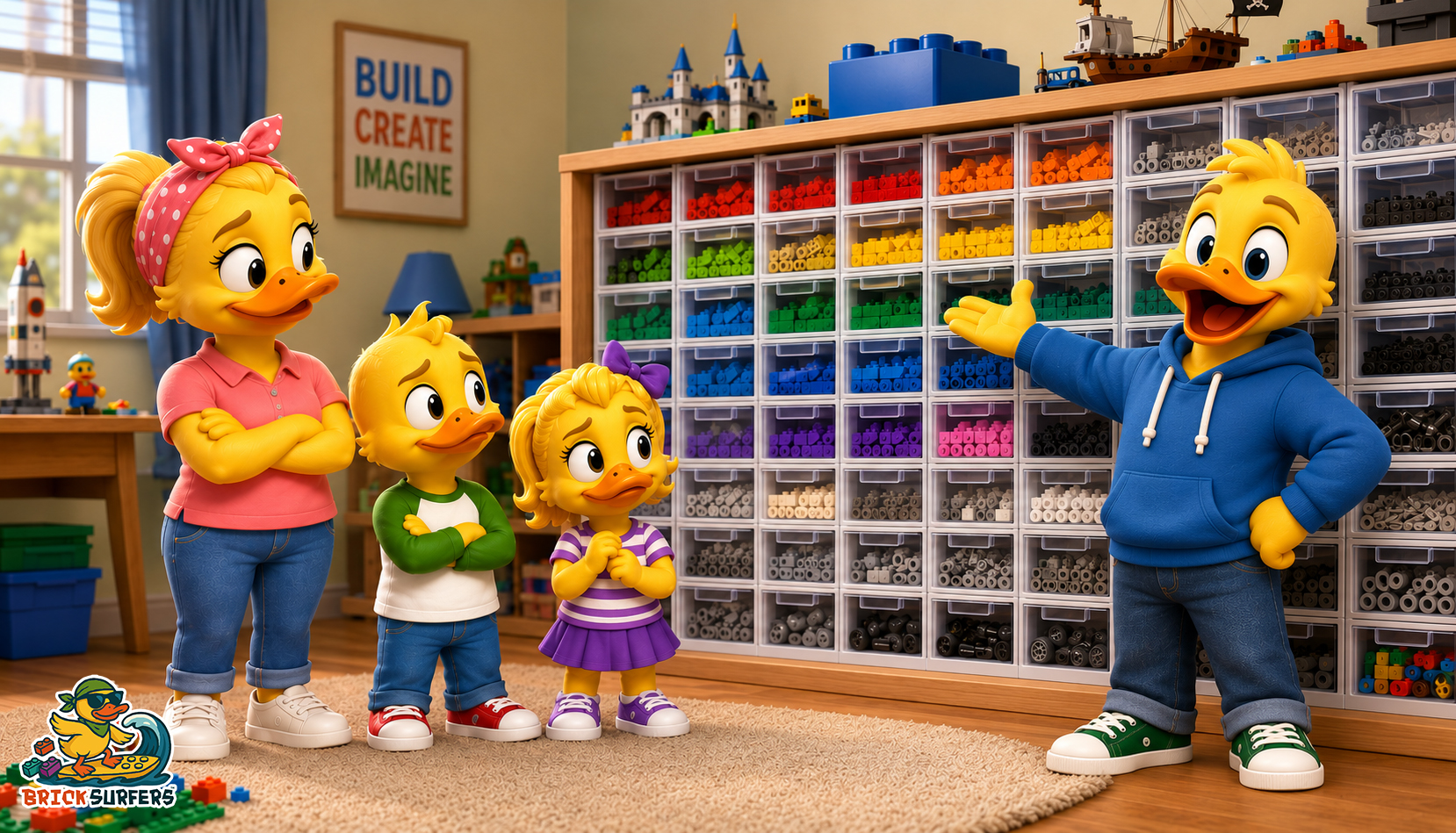
Most people don’t decide to turn their homes into a LEGO museum. Most people don’t even set out to have a “no kids allowed” basement like Will Ferrell’s character in The LEGO Movie. It usually starts small—a LEGO set or two for your kids, or maybe your parents dig out your old childhood tub of bricks. Suddenly you’re reliving old memories, buying a few more sets, sorting pieces into containers, making a trip to the hardware store for organizers, and before long you’ve got a tiny drawer for every piece type.
There’s certainly something satisfying about that level of organization. For many adult builders, collecting and organizing LEGO is part of the hobby. But when it comes to the LEGO your kids are actively using, I’d encourage a little caution.
For kids, LEGO bricks are a medium for exploration. They’re experimenting with ideas, telling stories, solving problems, and discovering what interests them. Creativity isn’t meant to start over from zero every single day.
Imagine if every evening your child had to erase everything they accomplished and begin again from scratch the next morning. That’s essentially what happens when every creation is completely dismantled and every brick meticulously sorted after each play session. Yes, we want to clean up. Yes, we want the house to stay livable. But a complete reset every time can interrupt the natural flow of creativity.
Instead, consider creating different “states” for your family’s LEGO.
Keep some creations “in progress.” Display a few finished masterpieces for a week or two. Have a “dismantle box” for builds that have run their course. And don’t be surprised when your kids raid last week’s spaceship to borrow the perfect wing piece for today’s dragon. That’s not ruining a creation—it’s exactly how creative thinking works.
When I was growing up, I loved building trap doors, secret passageways, and elevators. Certain pieces seemed to stay together because I kept reusing those same ideas in new creations. My newest builds stayed near the top of the LEGO bin until I was ready to take them apart. Looking back, I realize those weren’t unfinished projects—they were ideas still being explored.
Kids today often have far more LEGO than I ever did. LEGO collecting has become much more mainstream, and many families have impressive collections. But that doesn’t mean every brick has to live in a perfectly labeled drawer.
The purpose of organization isn’t to create a perfect collection. It’s to make the next great creation easier to build.
So by all means, organize your LEGO. Build systems that make cleanup easier and finding pieces faster. Just don’t let organization become the goal itself.
LEGO pieces aren’t meant to spend their lives as part of a perfectly curated museum exhibit tucked away in tiny plastic drawers. It’s meant to become castles, race cars, dragons, robots, spaceships, and whatever your kids dream up next.
Organize your LEGO bricks enough that creativity is easy.
But never so much that creativity becomes the very thing you’re protecting it from.