
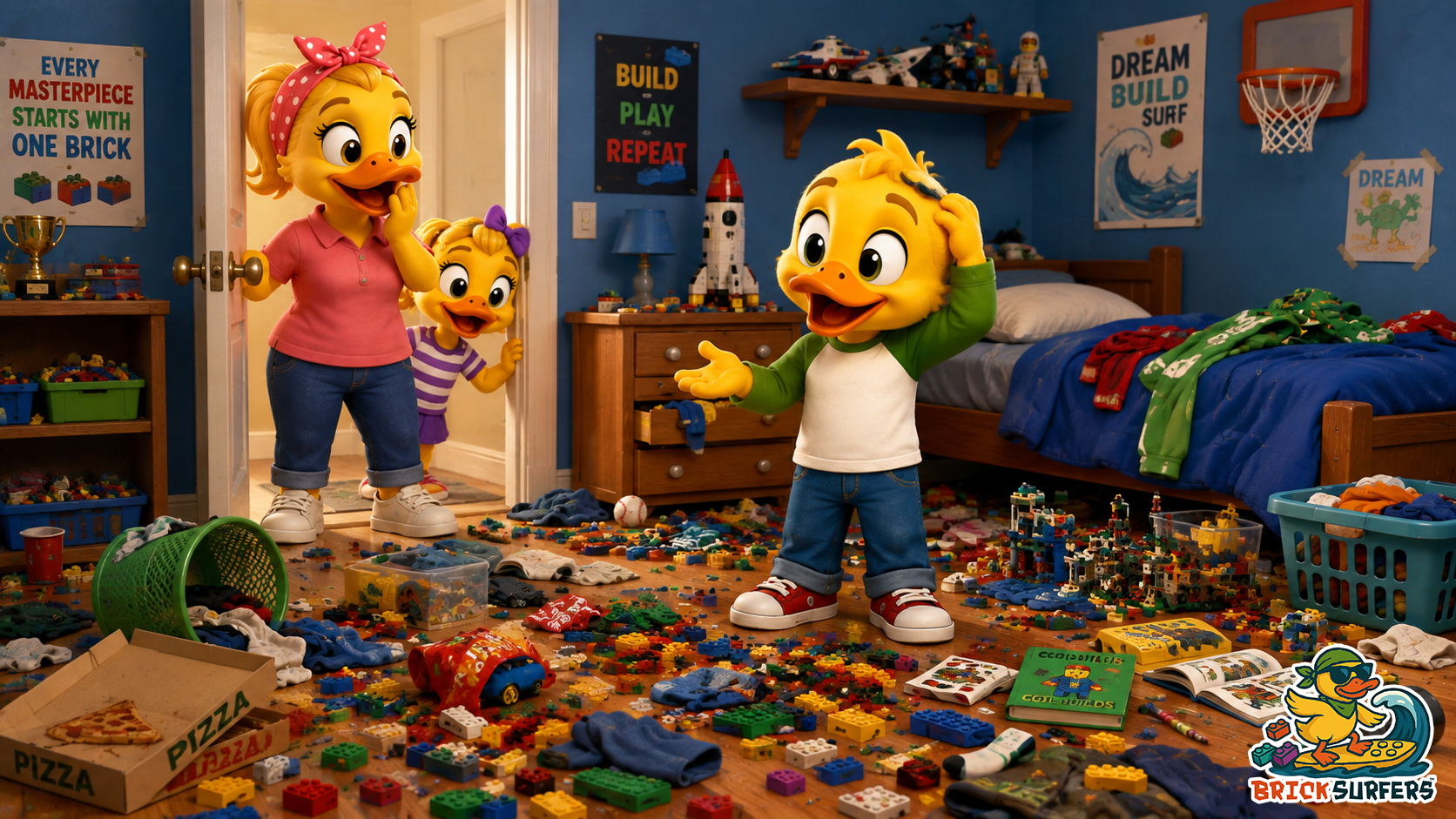
And maybe it’s more than just a LEGO disaster.
Maybe it’s a complete disaster.
It can be easy to walk into a very messy bedroom and get upset as a parent, especially when you work so hard to keep the rest of the house reasonably tidy.
What about guests? What will they think?
What will Grandma think? Her house is always immaculate!
Is there something growing in that corner?
Is there an overdue library book somewhere under that pile?
And exactly how many LEGO pieces are waiting between the bed and the bathroom for a barefoot 2 a.m. trip to the ER?
These are all normal things for a parent to worry about.
But before declaring the bedroom a federal disaster area, it might help to separate a few different problems that can easily get lumped together.
A messy bedroom isn’t necessarily an unsafe bedroom. And an untidy bedroom isn’t necessarily an unhealthy one.
Those are different problems, and they don’t all require the same response.
What Are We Actually Worried About?
Sometimes we’re worried about appearance.
Sometimes we’re worried about what other people will think.
Sometimes we’re worried that our child isn’t learning responsibility.
Sometimes there really is a safety or sanitation problem.
And sometimes there is simply too much stuff.
When we treat all five of those things as the same problem, “Clean your room!” becomes the solution to everything.
But maybe it isn’t.
Your child is a work in progress.
So are you.
You were once a child, too, and there’s a pretty good chance your bedroom got messy from time to time.
Or maybe it didn’t.
Maybe your parents drilled it into you that everything had to be picked up every day. Maybe your mother cleaned your room for you. Maybe you were naturally organized. Maybe there were serious consequences if things weren’t put away.
Whatever happened in your childhood doesn’t automatically have to become the rule for your child’s childhood.
Now it’s your turn to decide what you actually want your child to learn.
Your Guests Aren’t Bedroom Inspectors
Let’s deal with one of the easiest worries first.
If people are coming over, they probably aren’t headed straight for your child’s bedroom.
A reasonably tidy entrance, living room, kitchen, and bathroom go a long way toward making a home feel welcoming.
You don’t have to give every visitor a guided tour of every room.
Close the bedroom door.
There are plenty of perfectly ordinary reasons not to show guests what’s behind every door in your house. It’s your home, after all.
And Grandma?
Don’t worry too much about her, either.
She probably remembers better than anyone that life with young children can get messy.
School still happens.
T-ball still happens.
Scouts, church, homework, birthday parties, dentist appointments, family trips, and Tuesday nights when everybody gets home later than expected still happen.
Life doesn’t stop because somebody’s bedroom needs cleaning.
Some seasons are busier than others. Sometimes a room is going to get messier than usual.
You have permission to let that happen.
A Bedroom Is Also Their Space
For a child, a bedroom can be one of the first places in the world that feels like theirs.
That’s important.
Kids need spaces where they can play, build, imagine, read, draw, and sometimes simply be by themselves for a little while without being told what to do every second.
That doesn’t mean there shouldn’t be expectations.
There absolutely should.
Food shouldn’t be rotting under the bed. Dirty clothes shouldn’t become permanent carpeting. The door shouldn’t be blocked. And nobody should need protective footwear to cross the room.
But “safe and reasonably sanitary” doesn’t have to mean “ready for a magazine photo shoot.”
Part of growing up is gradually learning how to take responsibility for your own environment.
And that takes practice.
Sometimes the Problem Is Simply Too Much Stuff
Kids grow.
They outgrow sneakers. They outgrow clothes.
They also outgrow toys, books, interests, and even LEGO sets.
A child’s bedroom doesn’t have to become a museum of their entire childhood.
If every toy they’ve owned since preschool is still somewhere in the room, keeping that room clean may have become an impossible assignment.
Sometimes the answer isn’t:
“You need to get better at cleaning your room.”
Sometimes it’s:
“We need to make this room easier for you to manage.”
That’s a different conversation.
And it’s one that parents can help with.
Three Different Kinds of Cleaning
Instead of expecting a child’s bedroom to remain perfectly clean all the time, it can help to think about cleaning at three different levels.
Daily: Make It Safe
This doesn’t have to prolong bedtime.
Clear the walking paths.
Get food and dirty dishes out.
Put wet towels where they belong.
Make sure nobody is going to step on a LEGO spaceship on the way to the bathroom at 2 a.m.
You’re not resetting the entire room.
You’re making it safe for another day.
Weekly: Put the Room Back Together
Pick a time each week—often sometime during the weekend—to do a more thorough reset.
Clothes get gathered.
Trash goes out.
Books return to the shelf.
Toys return to their homes.
LEGO projects get moved somewhere safe, finished, displayed, or taken apart.
And somewhere along the way, you rediscover the floor.
Does it need to pass a white-glove inspection?
No.
Should everything be reasonably picked up and returned to its home?
Yes.
And if you’re out of town one weekend?
Skip it.
If the weekend is unusually busy?
Don’t make a big deal about it.
The cleaning routine exists to serve your family. Your family doesn’t exist to serve the cleaning routine.
Seasonally: Decide What Still Belongs
Then, once or twice a year, go deeper.
Some families do spring cleaning.
Others tackle it during summer break.
Others like to do it before the holidays—especially before another round of presents enters the house.
This isn’t just about cleaning.
It’s about volume.
What doesn’t fit anymore?
What hasn’t been touched in a year?
What has your child outgrown?
What could be donated to another child?
What LEGO creations are still important enough to display?
What can be photographed and taken apart?
What parts can go back into the collection?
The less unnecessary stuff you’re asking your child to manage, the easier it becomes for them to manage what’s left.
Give Things a Home
There’s another problem hiding inside the command to “clean your room.”
Where, exactly, is everything supposed to go?
It’s difficult to teach a child to put things away when “away” isn’t obvious.
That’s especially true with LEGO.
Where do loose pieces go?
Where does the half-built model go?
What happens to the instruction book?
Where can your child put a creation they’re not ready to dismantle?
What happens when LEGO has taken over the desk, and tomorrow that desk needs to become a homework space again?
That’s where adopting a SURF approach can help.
The goal isn’t to create a LEGO collection that looks perfect on Instagram.
It’s to create an environment that makes it practical for your child to use their LEGO collection—and practical to put it away when it’s time.
When everything has an understandable home, “Clean up this disaster!” becomes a series of much smaller tasks your child can actually accomplish.
You’re Not Really Raising a Clean Bedroom
Someday, the bedroom won’t be yours to worry about anymore.
Your child will have a dorm room, an apartment, or a home of their own.
And the goal isn’t that they’ll hear your voice in their head saying:
“What would Grandma think?”
Hopefully, they’ll be able to look around their own space and think:
This isn’t working anymore.
What needs to be cleaned now?
What can wait until Saturday?
What needs a better home?
What don’t I need anymore?
How can I make this space easier to live in?
That’s the skill we’re really trying to teach.
So yes, your child’s bedroom may currently be a LEGO disaster.
Maybe even a complete disaster.
But it can also be a place where your child practices taking ownership of their things, caring for their environment, making decisions, letting things go, and gradually becoming more capable.
And that’s worth a little mess along the way.