The Impending Mess
Every parent has a mental movie that plays out when their child asks, “Can I get the LEGO out?”
You’re probably not imagining the next thirty minutes of happy building. You’re imagining what happens afterward.
The bricks on the floor. The half-finished spaceship.
The cleanup battle.
The barefoot trip through the living room after bedtime.
Most “no’s” don’t happen because of the play.
They happen because of the cleanup.
The same thing is true for lots of creative activities. Finger paints. Homemade slime. Baking cookies. Each one comes with a mental picture of what the cleanup will involve. If that picture feels overwhelming, parents naturally become more hesitant to say yes.
One of my kids had a friend who went through a phase where they made homemade slime almost every day. The first attempt was about what you’d expect—a little chaotic. But after doing it over and over, they developed a routine. The ingredients lived in one place. Mixing happened in another. Cleanup always followed the same steps.
Once the process became predictable, slime stopped feeling risky.
LEGO works the same way.
Parents aren’t usually looking for perfect cleanup — they’re looking for predictable cleanup!
The Creativity Reset Button
When I was growing up, my Star Wars action figures lived in one drawstring bag, and my G.I. Joe figures lived in another.
During play, they often fought side by side.
During cleanup, I had one container for Star Wars figures and another for G.I. Joes.
My LEGO collection had its own home too. As my collection grew, the container changed—from a small LEGO suitcase to a much larger bin—but there was always a place where the bricks belonged when I was finished for the day.
What I wish I had known back then, though, is that cleanup doesn’t always have to mean putting everything away.
One of the biggest creativity killers I see is requiring kids to completely dismantle everything every time playtime ends.
Think about the stories kids create when they build.
The hero is still searching for the villain’s secret hideout.
The rocket still needs another level.
The princess still hasn’t finished preparing the grand feast.
Just because it’s time for dinner doesn’t mean the imagination is finished.
Adults understand this instinctively.
When I’m writing something, I almost never finish it in one sitting. In fact, I’ve found it’s often easier to stop while I still know exactly what I want to write next. When I come back later, I can jump right back in without having to rediscover where I was headed.
Kids do the same thing through play.
If they’re building a castle outside and you call them in for lunch, they don’t expect to bulldoze the castle before they eat. They simply put down their swords, enjoy their chicken nuggets and macaroni and cheese, and head right back outside afterward to finish storming the castle.
LEGO deserves that same opportunity.
Building a Better Pause Button
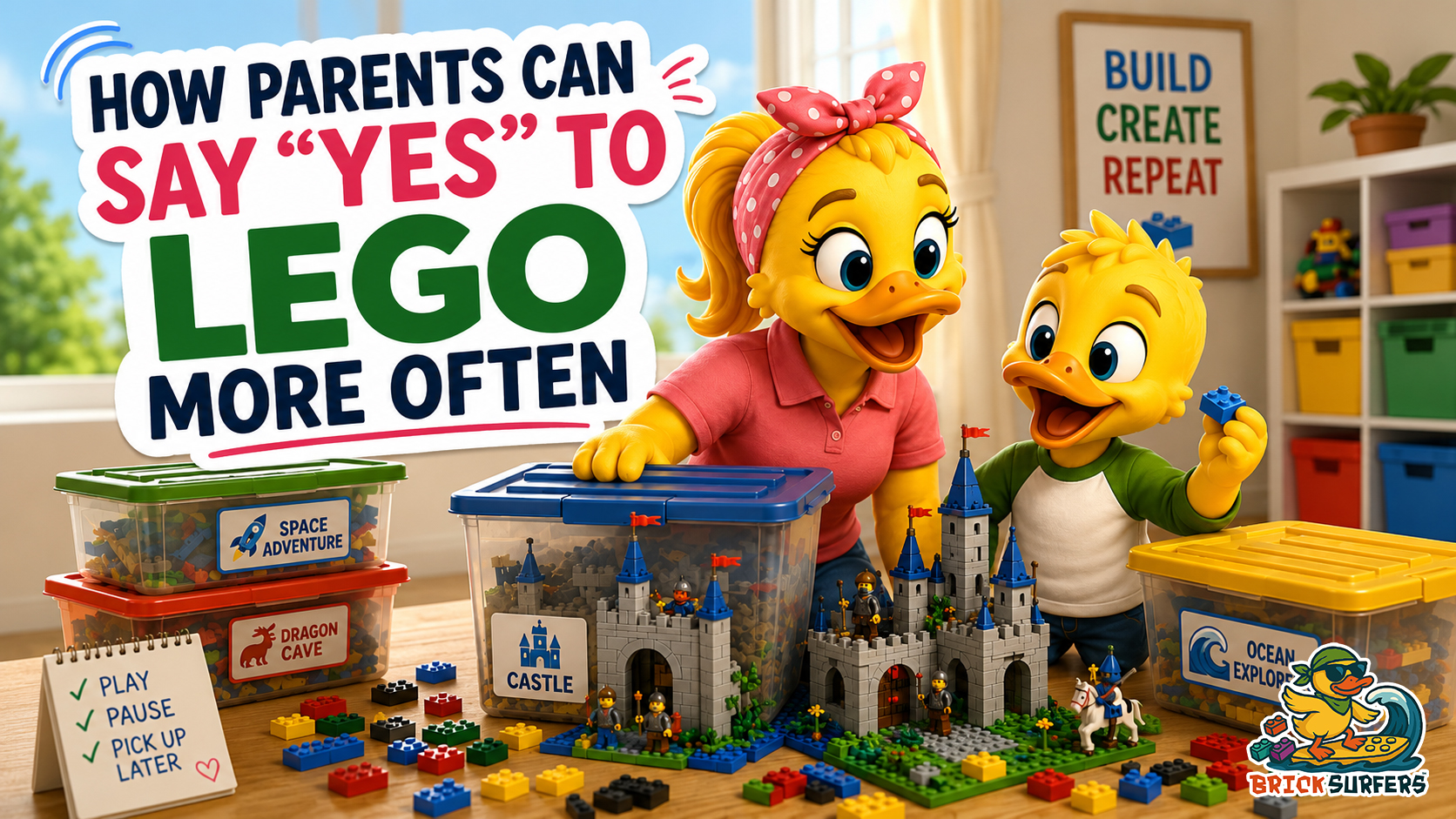
This is why I recommend using several shallow, clear plastic bins with lids instead of one giant “everything goes here” container.
Those bins aren’t just for storage.
They’re “pause buttons.”
A child can carefully place today’s city, spaceship, dragon cave, or race track into a bin, slide on the lid, and know they’ll be able to pick up exactly where they left off tomorrow.
The goal isn’t to preserve every creation forever.
It’s simply to preserve today’s creativity long enough for tomorrow.
Eventually, every project reaches its natural ending. At that point, the bricks can be returned to your larger organization system, ready for the next adventure. Or parts of them get adapted into the next adventure, while others go to the sort bin.
Bringing it Home
Take a moment to think about what your family expects when LEGO playtime ends.
Does cleanup always mean starting over?
Or does it simply mean making the room functional again?
Those aren’t the same thing.
When parents create a cleanup system that lets creativity pause instead of disappear, something interesting happens.
Cleanup becomes easier.
Arguments become fewer.
Kids become more invested in finishing what they started.
And perhaps most importantly…
It becomes much easier for parents to smile and say,
“Sure. Go get your LEGO.”