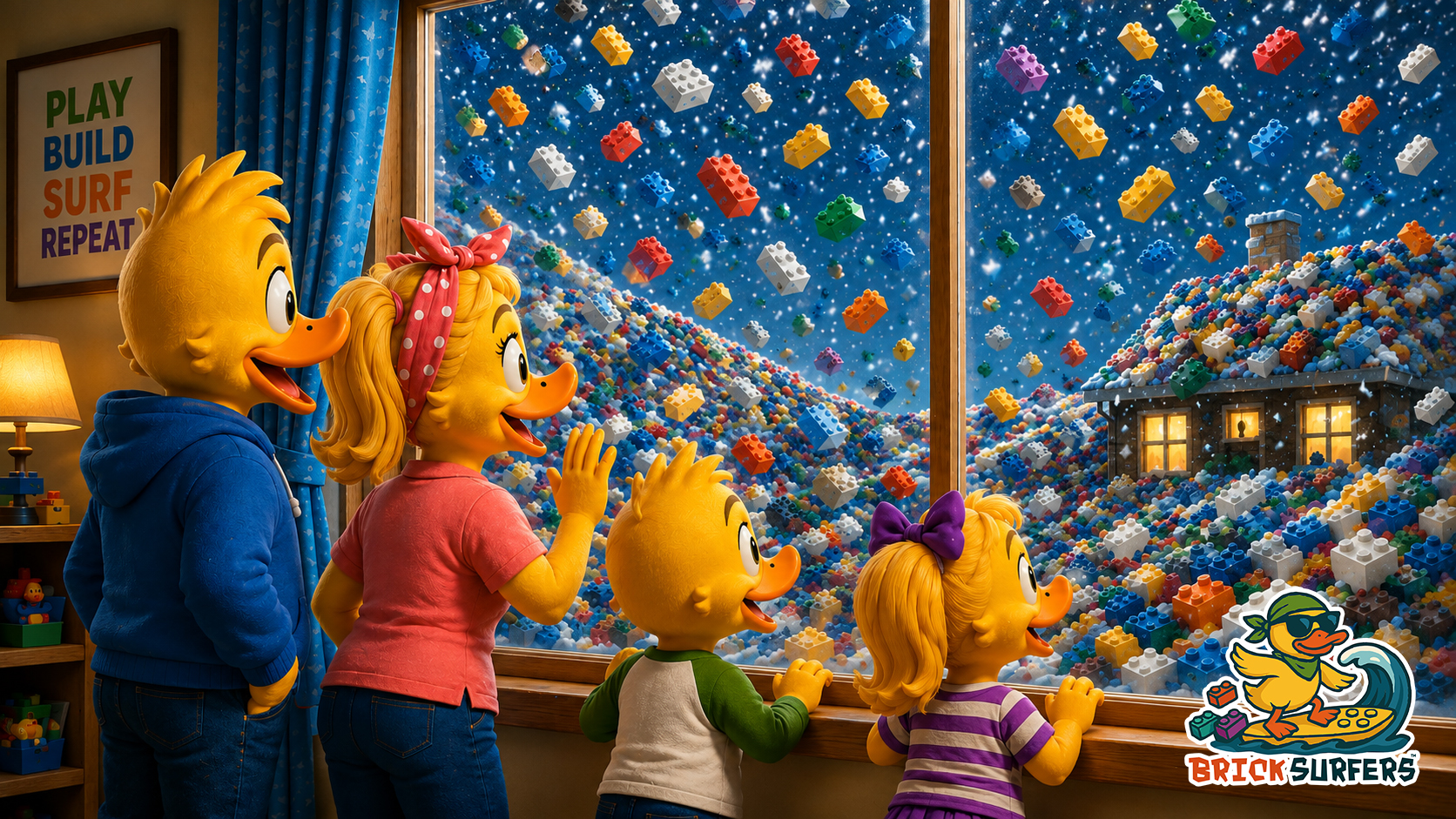
You’re usually thinking winter holidays when you hear this I’m sure, but with school being out for the summer, “Christmas in July”, Amazon Prime Day deals, Target and Walmart and other big companies all following suit, and the fact that I’m sure you’ve bought the kids at least one new LEGO set this summer, lots of kids probably feel like this is the most wonderful time of the year – summer break.
And who can argue with some downtime? And while this may mean summer camp and day camp and vacation bible school, and vacations, there are usually a few days for some time at home, especially for the kids. And this is exactly the time that you’re tempted to do that thing.
You know the thing. Time to sort the LEGO collection.
I’ve heard this one from too many parents to count. “We took a week to sort through the kids’ LEGO collections” to “we sorted everything out into bins by color” or “we got everything divided up into part types and put them into special drawers to make it easier to find things.”
I don’t need a crystal ball to tell you that most of these methods don’t last. And it’s not that I want to discourage you from sorting — who doesn’t want things tidied up?
But the trouble lies in the assumption and the approach.
First, the assumption — if we get it organized, once and for all, that settles it.
It really doesn’t. Not unless you don’t want them to ever play with the LEGO pieces again. And not if you, the parent, are going to get frustrated the next time you see a partially built spaceship, with several drawers emptied out.
Next, the approach — and here’s the kicker. I want you to think of the following phrase, as it is a core part of what defines the Brick Surfer approach:
Summer is for Surfing, not sorting.
Wait, you say, we don’t even live near the ocean, and how is surfing going to solve the LEGO Lava Pit erupting all over our house this summer?
I don’t mean surfing waves.
I mean learning to ride the waves of creativity instead of constantly fighting against them.
That’s Brick Surfing. A Brick Surfer is someone who tackles the LEGO mess in smarter ways, not harder ways. Brick Surfers look for approaches that work with a child’s natural inclination toward creativity (and chaos!) instead of constantly fighting against it.
Rather than spending a solid week sorting, try this instead:
Day 1 — Parade Building Challenge
Challenge your kids to collect all of their minifigures, and arrange them on baseplates (land pieces) into the world’s best parade.
What does this do?
It collects most (if not all) their minifigures. When they’re done with the parade, have them store all the minifigures in their own bin, rather than going back into the mix.
Day 2 — Race Car Building Challenge
Challenge your kids to collect all of their car parts — wheels, seats, steering wheels, car doors, rims, special slopes, engine pieces — anything that looks like it would make a cool race car — and build as many race cars as possible. Do you have a board or something that can be used as a car ramp? Let them race cars all day or all week.
What does this do?
It collects a lot of cool parts that can then be all stored together in a “car parts” box, or even given a few minutes of dismantling time — separate them out into smaller boxes. E.g. a box of wheels, a box of seats, etc.
Day 3 — Space Ship Building Challenge
Similar idea, except this time we’re collecting wings and computers, and transulcent pieces, and special “spaceship-looking” pieces.
Are you getting the picture?
Here are a few more to round it out:
Day 4 – Jungle Safari
Gather animals, plants, leaves, and tree pieces.
Day 5 – Skyscraper
Gather bricks, doors, windows, and structural pieces.
Day 6 – Castles & Fantasy
Gather gray bricks, arches, knights, dragons, horses, treasure, and fantasy accessories.
Day 7 – Rescue Team
Gather emergency vehicles, ladders, tools, helicopters, and rescue equipment.
There are lots of ways to approach building challenges, and it’s not hard to cater it to the interests of your child. No two children have the same LEGO sets. Each child is unique and could have building challenges aligned to their interests. This naturally creates an organization system that’s unique to your child. After you’ve done a few of these challenges, you’ll notice that your child’s LEGO collection has developed a very natural organization system that’s unique to the way they build.
A month later your child says, “I want to build a race car.” Instead of digging through twenty pounds of random pieces, they grab the Car Box. A week later they want a dragon. Out comes the Fantasy Box. Later they build robots, and suddenly some spaceship pieces migrate into that box instead. That’s okay. Your organization isn’t frozen in time. It’s evolving alongside your child’s imagination. The boxes evolve because your child’s interests evolve.
Traditional organization asks, “Where should this piece live?”
Brick Surfing asks, “What has my child been building? What are they likely to build next?”
Those are very different questions. And they lead to a very different kind of organization.
Most families start with “Play first, then organize.” After this gets too unwieldy, they tend to flip it around to “organize first, then play.” In Brick Surfers, we try to teach to play in ways that naturally create organization.
I know you’re busy, and don’t always have time to think these up on the fly. So each week we publish a new building challenge idea that includes a list of possible parts to collect. You can print out the building challenge (which then gives you a fun image to put in the container the child uses for the challenge), or show it to them on a computer or tablet. You can use the “building challenge” of the week, or pick an older one from the Resources tab, use one of these 7 above, or come up with your own.
Every day we can be creative while staying reasonably organized can mean that any day can be the most wonderful time of the year.