
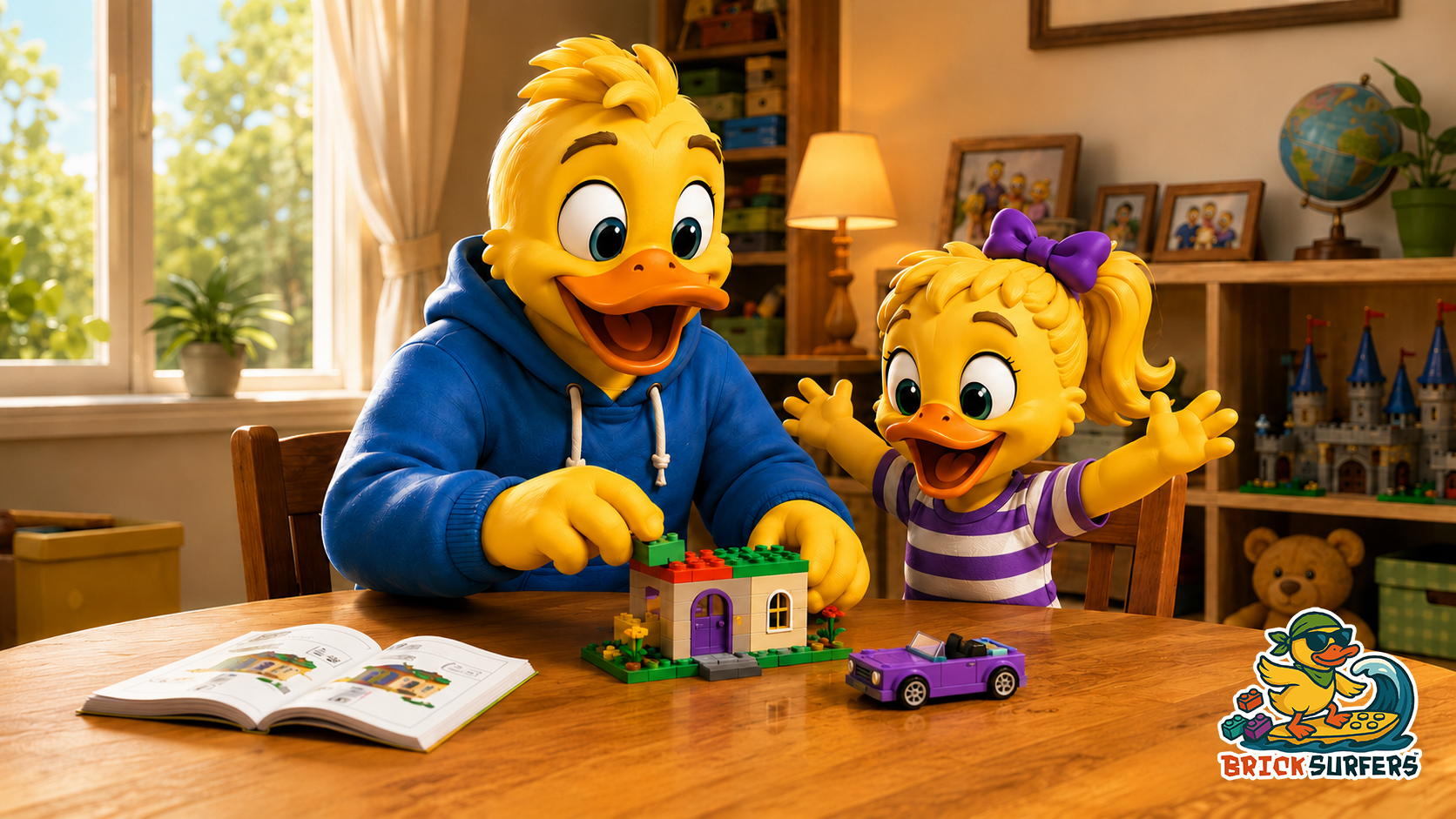
You help her open the box.
Her eyes light up as she dumps the bags onto a tray, and together you spread the instruction booklet across the table. You show her how the instructions tell her to open only one numbered bag at a time.
“Why?” she asks.
“Because it’s much easier to find the pieces that way,” you explain. “When I was a kid, none of the bags were numbered. Everything was mixed together.”
She giggles.
“That’s silly.”
“I know,” you laugh. “But it’s true.”
A few pages later, she builds her very first minifigure. She smiles as she snaps the last piece into place. The little character reminds her a bit of herself, and before long she’s giving it a voice and imagining tiny adventures.
As you continue, you show her how each step highlights only the new pieces being added. She studies the pictures carefully.
The first few steps are slow.
She puts a brick on backward.
You gently help her fix it.
She misses a piece.
Together you find it hiding under the instruction booklet.
Then, almost without warning…
…it clicks.
Suddenly she’s reaching for the next pieces before you can point them out. She isn’t asking nearly as many questions anymore. You can almost watch her confidence growing with every page she turns.
Step after step, the model begins to take shape.
Bag number two.
Then bag number three.
“Is this the last bag?” she asks, peeking into the empty box.
“It sure is.”
For just a moment, she looks disappointed. She’s been having so much fun building that she doesn’t want it to end.
Then you smile.
“As soon as you finish it, you get to play with it!”
Now she’s racing toward the finish line.
A few minutes later, the model is complete.
It’s a little car beside a roadside vegetable stand, complete with a few friendly animals. Her very first LEGO® set.
For the next several hours she rearranges the scene, invents stories, drives the little car around the house, and occasionally brings it back to you when something comes apart and she can’t quite snap it back together.
When bedtime arrives, she carefully places it on the little table beside her bed.
An hour ago, you opened a cardboard box.
Now there’s a finished LEGO model sitting on the table.
But that’s not the most important thing you built today.
You helped build things that will last much longer than plastic bricks.
- Patience, because worthwhile things are built one small step at a time.
- Perseverance, because mistakes can almost always be fixed and every challenge has a next step.
- Creativity, because once the instructions are finished, the real building is just beginning.
- Confidence, because she just accomplished something she couldn’t do an hour ago.
- Family memories, because years from now neither of you will remember exactly how many pieces were in that set—but you’ll remember building it together.
As the years go by, she’ll tackle bigger and more complicated sets. She’ll create stories of her own. She’ll rebuild old favorites. She’ll decide which spaceship parks outside the pizza shop, which animal lives on top of the skyscraper, and why the police officer had to pull over the robot with the expired registration.
Those stories may seem like simple play.
They’re not.
Every imaginary adventure is practice for real life. As children invent characters, solve problems, negotiate disagreements, and imagine new possibilities, they’re developing skills they’ll carry long after today’s model has been taken apart.
One day the bricks from that very first set may end up mixed into a larger collection. The little roadside stand may disappear into a bin of thousands of pieces.
But something else will remain.
A child who has grown a little more patient.
A little more confident.
A little more creative.
And a family that built something together.
The best thing your child builds with LEGO isn’t made of LEGO at all.