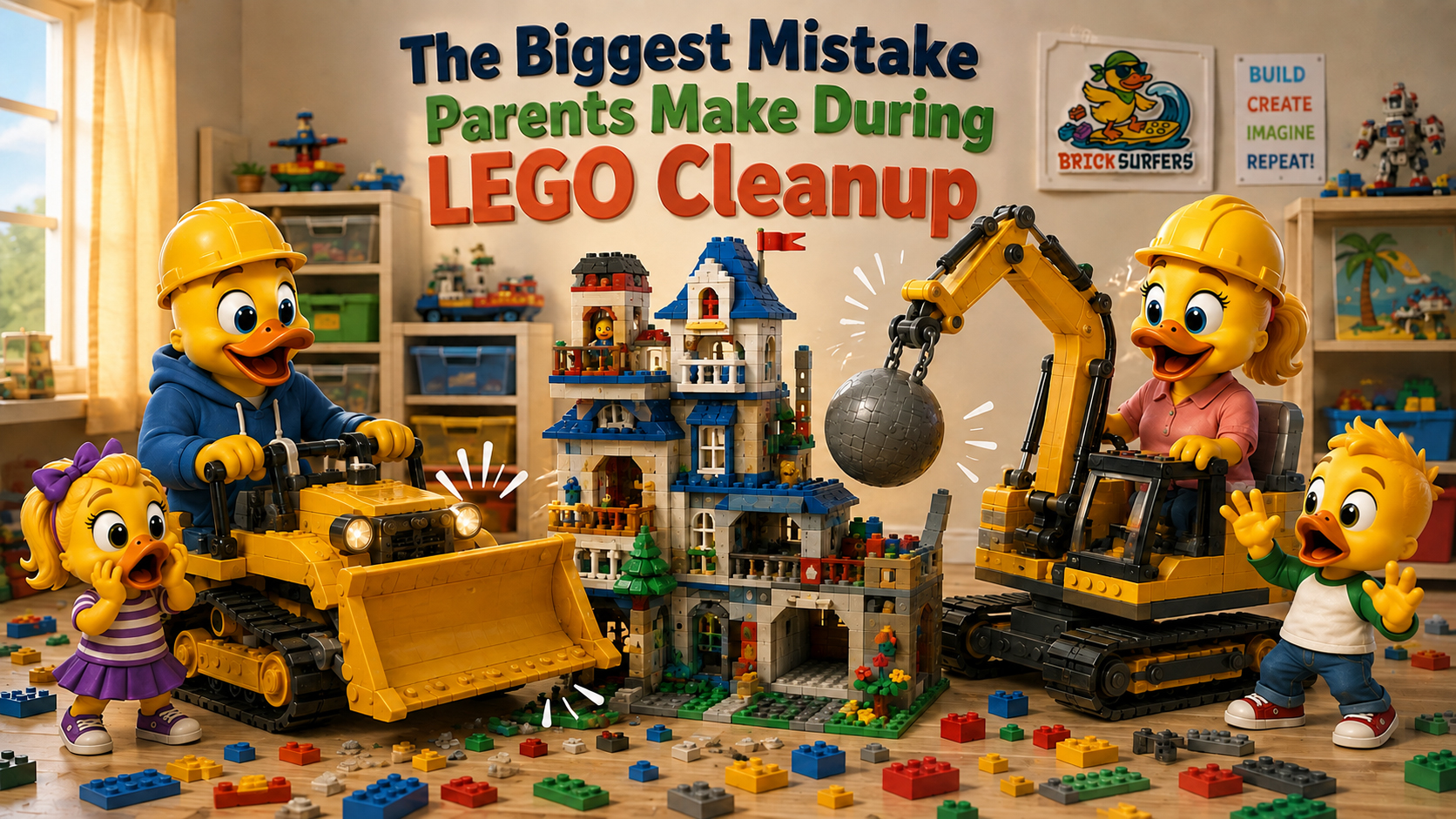
Have you ever watched a building being demolished?
Maybe you’ve seen a bulldozer or excavator clearing an old structure. Maybe you’ve watched a wrecking ball smash through a wall. Or perhaps you’ve seen one of those videos where carefully placed explosives bring an entire building crashing down in seconds.
There are times when demolition makes sense. Sometimes you really do need to tear down the old to make way for something new.
But imagine if every construction project started that way.
Sometimes I think that’s how we approach LEGO cleanup.
Playtime is over, so every creation gets dismantled. Every wall comes apart. Every vehicle gets reduced to individual pieces. Everything goes back into the bin until we’ve returned the LEGO collection to a perfectly level playing field.
Next time, the child can start completely from scratch.
But why does cleanup have to mean demolition?
Cleanup, Putting Away, and Dismantling Aren’t the Same Thing
I think it’s helpful to distinguish between three things we often lump together:
Cleanup means getting the LEGO bricks and creations out of places where they shouldn’t be. We’re getting pieces off the floor, clearing the walkway, or getting the dining room table ready for dinner.
Putting away means moving those bricks and creations to the places we’ve decided they belong. Loose pieces might go into a bin. A vehicle might go onto a shelf. An unfinished creation might move to a designated building area.
Dismantling means taking something apart so the individual pieces can be used for something else.
All three have a place.
The mistake is assuming that cleanup always requires all three.
Sometimes the room needs to be cleaned up, but the creation doesn’t need to be dismantled.
Not Every New Idea Needs to Start From Scratch
When I was growing up, I had a treehouse that changed over time. It started as a fairly simple platform and eventually gained walls and became something more substantial.
But I had a friend whose treehouse took that idea much further.
His dad was a builder, and as my friend got older, the treehouse grew with him. Eventually it had a roof. It was insulated. They even ran electricity to it.
His dad used that treehouse as an opportunity to teach him more about building. They didn’t cut down the old tree, throw away everything they’d built, and start over every time my friend was ready to learn something new.
They built on what was already there.
That’s often how creativity works.
Your child’s LEGO creation might have started as the model pictured on the box. But over time, a few pieces disappeared. Maybe the wheels ended up on another vehicle. A wall got scavenged to build a castle. A minifigure moved into an entirely different adventure.
Eventually, the original set might barely resemble what came in the box.
And beside it might be some strange-looking creation assembled from parts of five other things.
To us, both can look like a mess.
To the child, they may be works in progress.
Sometimes the Old Creation Is the Starting Point
A partially built creation can give a child somewhere to begin.
Maybe yesterday’s spaceship becomes today’s underwater research station. A chunk of wall from an old castle becomes part of a secret headquarters. A vehicle gets longer, stranger, and covered with increasingly ridiculous gadgets.
The child doesn’t necessarily need a blank canvas every time.
Sometimes what they built yesterday is the raw material for what they’ll imagine today.
That’s what happened with my friend’s treehouse. Adding a roof and electricity was much easier because there was already something there to build upon. Eventually, there might have come a point when the old structure no longer worked and starting over made more sense.
LEGO creations work the same way.
There absolutely comes a time to dismantle things.
But dismantling doesn’t have to be the default ending to every building session.
Make Room for Works in Progress
Of course, families have limited space.
I’m not suggesting that every LEGO creation your child has ever made should be preserved forever, slowly consuming the entire house.
There can still be boundaries.
Maybe there’s a shelf where completed creations can live. Maybe there’s a building table where works in progress can stay between play sessions. Maybe there’s a bin where larger “chunks” can be put away without having to break them into individual pieces.
The amount of space isn’t as important as the principle:
Give your child some room for things that aren’t finished yet or are an ongoing story in development.
It may be more space-efficient to dismantle every creation and fit every LEGO piece into the smallest possible container.
But raising children isn’t always about finding the most space-efficient solution.
We’re also trying to give them room to grow, experiment, create, and develop their own ideas.
Let Dismantling Become Part of Building
Eventually, your child will need those pieces.
They’ll look at an old creation and realize that the hinge they desperately need is buried inside it. They’ll decide that yesterday’s spaceship isn’t nearly as interesting as the robot they’re imagining today.
That’s a great time for dismantling.
If there’s a stubborn chunk they can’t get apart, help them with it. If they decide an old creation has run its course, help them tear it down and put the pieces back into circulation.
Over time, old creations naturally give way to new ones.
The important difference is that dismantling becomes part of the child’s creative process rather than something imposed automatically at the end of every play session.
Most children aren’t going to maintain dozens of enormous completed models forever. They’re going to have a handful of creations, scenes, vehicles, buildings, and strange little chunks connected to whatever they’re currently imagining.
Let those ideas breathe for a while.
Cleanup can mean getting the bricks off the floor.
Putting away can mean moving today’s adventure somewhere safe.
And dismantling can wait until your child is ready to turn what’s already there into something new.
Because sometimes the best place to start building isn’t from scratch.
It often starts with what you built yesterday.