
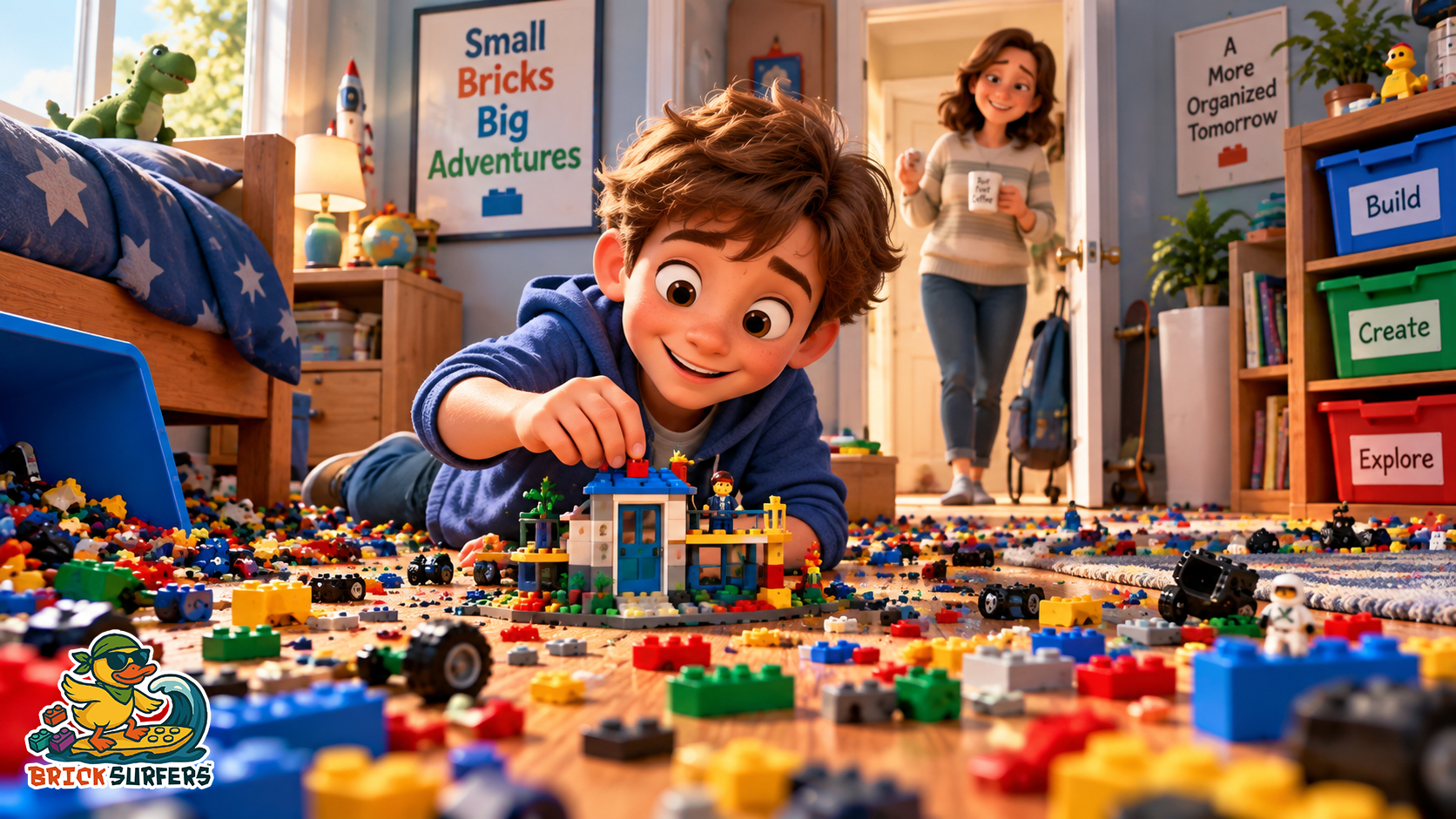
Imagine opening the bedroom door in the morning, stepping out into the hallway, and immediately stepping on a LEGO brick.
You might not have to imagine it … it just happened this week!
In fact, I wouldn’t be surprised if you can spot LEGO pieces in nearly every room of the house. A few on the floor. A half-finished creation on the kitchen counter. A mysterious pile of parts trying to hide under a bed. Somehow, no matter how many times you pick them up, they seem to sprout back up out of the woodwork.
Welcome to the LEGO Brick Lava Pit.
It’s what happens when a family’s LEGO collection grows faster than its systems.
It’s not usually caused by having too much LEGO. It’s caused by not having –clear expectations– about where building happens, where creations go when they’re finished, and what happens to all those pieces between building sessions.
Without a plan, the LEGO bricks start to spread.
The LEGO Lava Pit is every little piece of plastic seeming to erupt from the very carpet and floorboards. It is construction toys bubbling from every conceivable surface in the house, falling out of lunchboxes, swimming in your bathtub, and from time to time, forming spontaneous piles in the most unimaginable forgotten corners of your home.
Okay… hopefully it’s not quite that bad.
But unchecked, LEGO pieces seem to spawn out of nowhere like dust bunnies, head lice, and bad excuses.
And it’s not because you had bad intentions.
Everything seemed so simple when your child opened that very first LEGO set.
Back then, it was easy to keep up with.
Then a birthday showed up.
Then a holiday.
Then a good-behavior bribe at the grocery store.
Then a sale at Target when you tried to quickly cut through the toy aisle. You knew better, didn’t you?
And before long, there are LEGO pieces everywhere.
The funny thing is that the mess usually comes from something wonderful.
It’s hard to overlook the joy on a child’s face when they’re building. They’re following directions. They’re engaged. They’re developing fine motor skills and paying attention to details.
And then there’s the play.
Hours of it.
They’re using their imagination. They’re role-playing. They’re inventing new things and testing creative ideas. They’re practicing what it means to be human through play.
LEGO is wonderful.
The chaos isn’t.
Over time, things can get a little messy, especially as the collection grows.
The first kit or two didn’t need much organizing.
But now there are bins full.
Most families never decide how LEGO is supposed to work in their home. They simply keep acquiring more LEGO and solving problems one brick avalanche at a time.
And somehow you missed picking up that “Parents Guide to LEGO Parenting” when you bought the first set.
You know, the one that doesn’t actually exist.
The one that explains how to handle a LEGO collection as it grows and changes and evolves with your child from age four to fourteen—and maybe beyond.
Fortunately, most parents and most kids survive LEGO building.
Many carry it into adulthood.
Quite a few adults even credit LEGO building as part of what inspired their careers in engineering, design, architecture, programming, education, and countless other fields.
The good news is that the LEGO Lava Pit isn’t permanent.
You don’t need to sort every brick by color.
You don’t need expensive storage systems.
You don’t need to throw everything away and start over.
You just need a better way to surf the wave.
A place for building.
A place for creations.
A way to celebrate the architects.
A system that helps the pieces stay off the floor and the creativity stay alive.
That’s what Brick Surfers is all about.
Because the goal was never to just survive parenting with as few LEGO wounds as possible.
The goal is to spend less time fighting the mess and more time enjoying the adventure.